
Last Updated 07/21/2026
Los Angeles Stormwater Laws & Regulations
The County of Los Angeles has enacted a Stormwater Ordinance in order to establish minimum stormwater management requirements and controls to protect and safeguard the general health, safety, and welfare of the public residing in watersheds within this jurisdiction. The County of Los Angeles is the permitting authority for all land disturbing activities and requires the land owner to maintain all on-site stormwater control facilities and all open space areas (e.g. parks or “green” areas) required by the approved stormwater control plan. The County of Los Angeles will only provide construction permits to projects that establish a plan to manage stormwater runoff occurring during the construction process. The County of Los Angeles, under the NPDES program, also has the authority to inspect properties for noncompliance and can issue a notice of violation (NOV) for any deficiency or infraction onsite. Property owners are responsible for the maintenance of any stormwater facilities or practices located on the property. The County of Los Angeles has the authority to inspect stormwater facilities and practices in order to ascertain that they are properly maintained and functioning.
The County of Los Angeles regulations are compliant with the National Pollutant Discharge Elimination System (NPDES) through municipal regulation Los Angeles County Code (LACC), Title 12, Chapter 12.80. The county’s Municipal Separate Storm Sewer System (MS4) requires Los Angeles to administer and enforce compliance with stormwater discharge permits in an effort to decrease stormwater pollutants and increase overall water quality. The Los Angeles County MS4 has jurisdiction over 84 of its incorporated cities (not including Avalon, Lancaster, Long Beach, and Palmdale), with the County of Los Angeles Department of Public Works Watershed Management Division listed as the principal permittee.
EXCERPT- Los Angeles County Code (LACC), October 2018
Title 12 Environmental Protection Chapter 12.80 Stormwater and Runoff Pollution Control
Part 3 – DISCHARGE TO THE STORM DRAIN SYSTEM
12.80.480 – Public facility sources required to obtain a NPDES permit.
Any public facility required to have a NPDES permit shall retain on-site and, upon request, make immediately available to the director the following documents as evidence of compliance with permit requirements, as applicable:
A. A copy of a NPDES permit or notice of intent to comply with a general permit to discharge stormwater associated with industrial activity as submitted to the state board or report of waste discharge as submitted to a regional board of jurisdiction;
B. A waste discharge identification number issued by the state board or copy of the NPDES permit issued by a regional board;
C. A SWPPP and a monitoring program plan or group monitoring plan;
D. Stormwater quality data; and
E. Evidence of facility self-inspection
12.80.490 – Notification of uncontrolled discharges required.
A. Upon the discovery of an uncontrolled discharge to the storm drain system, the discharger or permittee shall immediately notify the director of the incident by telephone in addition to any other notifications to public agencies as may be required by law. The notification shall include location of the discharge, type of materials discharged, estimated concentration and volume of the discharge, and corrective actions taken to contain or minimized the effects of the discharge.
B. Within 10 calendar days after the first discovery of the uncontrolled discharge, the discharger or permittee shall submit to the director a detailed written report describing the cause of the discharge, corrective action taken and measures to be taken to prevent future occurrences, and measures taken to remediate the effects of the discharge. Such notification shall not relieve the discharger or permittee from liability or fines incurred as a result of the uncontrolled discharge.
12.80.460 – Prohibited discharges from industrial or commercial activity.
The following discharges from industrial or commercial activities are prohibited unless the discharge is in compliance with a NPDES permit:
A. Discharge of wash waters to the storm drain system from the cleaning of gas stations, auto repair garages, or other types of auto repair facilities;
B. Discharge of wastewater to the storm drain system from mobile auto washing, steam cleaning, mobile carpet cleaning, and other such mobile commercial and industrial operations;
C. Discharge to the storm drain system from areas where repair of machinery and equipment, including motor vehicles, which are visibly leaking oil, fluids or coolants is undertaken;
D. Discharge to the storm drain system from storage areas for materials containing grease, oil, or hazardous materials, or uncovered receptacles containing hazardous materials, grease, or oil;
E. Discharge of commercial/public swimming pool filter backwash to the storm drain system;
F. Discharge from the washing of toxic materials from paved or unpaved areas to the storm drain system;
G. Discharge from the washing out of concrete trucks to the storm drain system; or
H. Discharge from the washing or rinsing of restaurant mats, equipment or garbage bins or cans in such a manner that causes nonstormwater to enter the storm drain system.
12.80.470 – Industrial/commercial facility sources required to obtain a NPDES permit.
Any industrial or commercial facility required to have a NPDES permit shall retain on-site and, upon request, make immediately available to the director the following documents as evidence of compliance with permit requirements, as applicable:
A. A copy of a NPDES permit or notice of intent to comply with a general permit to discharge stormwater associated with industrial activity as submitted to the state board or report of waste discharge as submitted to a regional board of jurisdiction;
B. A waste discharge identification number issued by the state board or copy of the NPDES permit issued by a regional board;
C. A SWPPP and a monitoring program plan or group monitoring plan;
D. Stormwater quality data; and
E. Evidence of facility self-inspection.
Part 4 – RUNOFF MANAGEMENT REQUIREMENTS
12.80.520 – Best management practices for industrial and commercial facilities.
All industrial and commercial facilities shall implement BMPs to the maximum extent practicable. Minimum BMPs applicable to all industrial and commercial facilities include, but are not limited to:
A. Termination of all nonstormwater discharge to the storm drain system that is not specifically authorized by a NPDES permit;
B. Exercising general good housekeeping practices;
C. Incorporating regular scheduled preventive maintenance into operations;
D. Maintaining spill prevention and control procedures;
E. Implementing soil erosion control;
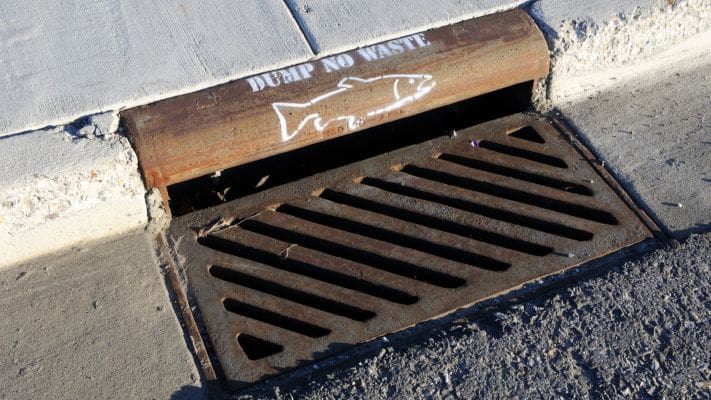
F. Posting on-site private storm drains to indicate that they are not to receive liquid or solid wastes;
G. Implementing regular cleaning of the on-site private storm drain system; and H. Insuring that stormwater runoff is directed away from operating, processing, fueling, cleaning and storage areas.
Part 5 – VIOLATIONS AND ENFORCEMENT
12.80.580 – Inspection to ascertain compliance—Access required.
A. The director may inspect in a manner authorized by state law, as often as he/she deems necessary, any publicly or privately owned storm drain, storm drain connection, street, gutter, yard, plant, storage facility, building, BMP, NPDES permit, SWPPP, stormwater management plan, construction activity or other facility to ascertain whether such facilities, plans, or protective measures are in place, maintained and operated in accordance with the provisions of this chapter.
B. In the course of such inspection, the director may:
1. Inspect, sample, make flow measurements of any runoff, discharge or threatened discharge;
2. Place on the premises devices for runoff or discharge sampling, monitoring, flow measuring or metering;
3. Inspect, copy, or examine any records, reports, plans, test results or other information required to carry out the provisions of this chapter, to the extent allowed by law; and
4. Photograph any materials, storage areas, waste, waste containers, BMP, vehicle, connection, discharge, runoff and/or violation discovered during an inspection.
12.80.600 – Notice to correct violations—Director may take action.
The director may issue a notice of violation and order to comply to achieve compliance with the provisions of this chapter. Failure to comply with the terms and conditions of a notice of violation and order to comply shall constitute a violation of this chapter.
If a person fails to comply with an order issued under this section to remove an illicit connection, obstruction or other encroachment to the storm drain system, the director may perform the work as provided in Section 12.80.620 of this chapter. The person responsible for installing or operating such a facility shall be liable to the county for the cost of such work, including reasonable attorneys fees and other costs of enforcement, to be recovered in a civil action in any court of competent jurisdiction.
12.80.620 – Nuisance abatement—Director to perform work when—Costs.
Whenever a nuisance shall be found to exist on any premises, the director may summarily abate such nuisance upon determination that the nuisance constitutes an immediate threat to public health or safety, or the director may notify in writing the person(s) having control of or acting as agent for such premises to abate or remove such nuisance within such time as is stated on the notice. Upon the failure or refusal of such person(s) to comply with the notice, the director may abate such nuisance in the manner provided by law. The person(s) having control of such premises, in addition to the penalties provided by this chapter, shall be liable to the county for any costs incurred by the county for such abatement, including reasonable attorneys fees and other costs of enforcement, to be recovered in a civil action in any court of competent jurisdiction.
12.80.630 – Violation—Penalty.
Any person violating any provision of this chapter shall be guilty of a misdemeanor. Such violation shall be punishable by a fine of not more than $1,000.00 or by imprisonment in the county jail for a period not to exceed six months, or by both such fine and imprisonment. Each day during any portion of which such violation is committed, continued or permitted shall constitute a separate offense and shall be punishable as such.
12.80.635 – Administrative fines.
The amount of an administrative fine imposed pursuant to Chapter 1.25 of this code for delinquent fees, as described in Section 12.80.780, shall be ten percent of the delinquent amount for each month, or any portion thereof, that the fees are delinquent. For any other violation of this chapter, the amount of an administrative fine shall not exceed $100.00 for the first violation, $200.00 for the second violation of the same provision of this chapter within one year after the first violation, and $500.00 for each additional violation of the same provision of this chapter within one year after the first violation.
Part 6 – REGISTRATION AND INSPECTION OF INDUSTRIAL/COMMERCIAL FACILITIES
12.80.710 – Applicability.
The provisions of this Part 6 shall apply to the following facilities, if such facilities are located in any county unincorporated area that is covered by a NPDES municipal stormwater permit requiring tracking and inspection of facilities that are critical sources of stormwater pollution:
A. The following commercial facilities:
1. Restaurant facilities;
2. Automotive service facilities;
3. Automotive dealerships; and
4. Retail gasoline outlets
12.80.730 – Exempt facilities.
A facility is not required to be registered in accordance with Section 12.80.720 if the director determines that:
A. The facility is described in Section 12.80.710, but the manufacturing, storage, packaging, transportation or other primary activities upon which the classification is based do not take place at the facility or on any contiguous property, and the facility does not have the potential to contribute pollutants to any stormwater runoff that is discharged from the facility;
B. The facility is included within another facility that is registered and for which a certificate of inspection is in full force and effect;
C. The discharge of stormwater runoff from the facility is authorized by and subject to the requirements of a Small Municipal Separate Storm Water Sewer System (Phase II) NPDES permit or a site-specific NPDES permit incorporating stormwater runoff requirements; or
D. The owner or operator of the facility is required by a NPDES municipal stormwater permit to implement a public agency activities program to minimize stormwater pollution impacts from its activities.
12.80.720 – Registration required.
A. Within 30 days after the effective date of the ordinance codified in this Part 6 or such later time as may be established by the director, or within 30 days after commencing business, whichever is later, the owner or operator of any facility described in Section 12.80.710 shall register the facility with the director.
B. The director will provide printed registration application forms, indicating thereon the information to be furnished. The director may authorize electronic submittal of registration applications in a manner consistent with county policy in lieu of the printed application forms.
D. The registration application must be accompanied by the registration fee and the first annual certificate fee in the amounts set forth in Section 12.80.780. The registration fee and first annual certificate fee are non-refundable, with the exception of facilities determined to be exempt pursuant to Section 12.80.730 within one year after the fees were paid, where the director determines that the facility met the requirements of subsection A, B, C, or D of Section 12.80.730 at the time the fees were paid.
F. The director must be notified in writing within five business days of any changes in the information contained in the registration application or otherwise submitted to the director for a registered facility. G. A new registration application must be submitted within 30 days for any changes in the industrial/commercial activities or principal products produced at the facility or in the location or ownership of the facility unless the director determines that a new application is not necessary.
12.80.740 – Certificate of inspection—Issuance by the director.
A. When the director has inspected a registered facility, or has caused the facility to be inspected, and the director has determined that the facility is in compliance with this chapter and with any applicable requirements of a NPDES municipal stormwater permit and that all applicable fees as set forth in Section 12.80.780 have been paid, the director will issue a certificate of inspection to the registered facility. The certificate may contain conditions and limitations appropriate to meet the objectives of this chapter.
B. A copy of the certificate must be maintained at the facility and made available upon request to the director and any interested persons.
C. The certificate will expire one year from the date of its issuance unless extended by the director. The director will issue a new certificate of inspection upon a determination that the requirements of subsection A of this section have been satisfied, including payment of a new annual certificate fee in the amount set forth in Section 12.80.780.
View State Page
Frequently Asked Questions
Does Los Angeles County's stormwater ordinance apply to every city in the county?
Not entirely. The county’s MS4 permit covers 84 of its incorporated cities, but Avalon, Lancaster, Long Beach, and Palmdale are excluded, meaning those four cities administer their own separate stormwater programs rather than falling under the County Department of Public Works Watershed Management Division as principal permittee.
What discharges are automatically prohibited for commercial and industrial properties in LA County?
A specific list, unless covered by an NPDES permit. That includes wash water from auto repair or gas station cleaning, mobile pressure washing and steam cleaning operations, runoff from areas where leaking machinery is repaired, discharge from uncovered hazardous material or grease storage areas, swimming pool filter backwash, concrete truck washout, and washing restaurant mats, equipment, or garbage bins in a way that sends non-stormwater into the drain system.
Does my restaurant or auto shop need to register with LA County for stormwater inspections?
Likely yes, if it’s in unincorporated county territory covered by the relevant MS4 permit. Restaurant facilities, automotive service facilities, automotive dealerships, and retail gasoline outlets all fall under the county’s registration and inspection program, unless a specific exemption applies, such as being covered under a separate Phase II permit or already registered as part of another facility.
What happens after I register my facility with LA County?
The county inspects it, and once compliance is confirmed, issues a certificate of inspection that has to be posted at the facility and shown to the director or interested parties on request. That certificate expires one year after issuance, so renewal, including a new annual certificate fee, is required to keep it valid.
What do I have to do if there's an uncontrolled discharge on my LA County property?
Notify the director immediately by phone, including the discharge’s location, materials involved, estimated volume, and what corrective action you’ve taken. Within 10 calendar days, you also have to submit a detailed written report covering the cause, corrective steps, and prevention measures. Neither notification removes your liability for fines tied to the discharge itself.
How much can a stormwater violation cost in LA County?
It depends on the type. A criminal violation is a misdemeanor punishable by up to $1,000 in fines, up to six months in county jail, or both, with each day of continued violation counting as a separate offense. Administrative fines run on an escalating scale instead: up to $100 for a first violation, $200 for a second within a year, and $500 for each additional violation within that same year.
What best management practices does LA County require from commercial and industrial facilities?
A defined minimum set, implemented to the maximum extent practicable. That includes ending any unauthorized non-stormwater discharge, general good housekeeping, scheduled preventive maintenance, spill prevention procedures, erosion control, posting private storm drains as not for waste disposal, regular cleaning of those private drains, and directing runoff away from fueling, processing, and storage areas.
Can LA County inspect my property without much advance notice?
Yes. The director can inspect any storm drain, connection, facility, or BMP as often as deemed necessary, and during that inspection can sample discharge, install monitoring devices, examine records and plans, and photograph anything relevant to a potential violation.
How can AQUALIS help my property stay compliant with LA County's stormwater ordinance?
AQUALIS helps LA County property owners register qualifying facilities, maintain the annual certificate of inspection, implement the required BMPs for industrial and commercial sites, and respond quickly to an uncontrolled discharge before the 10-day written report deadline passes.
The information on this page is provided for general informational purposes only and is not legal advice. Regulations change frequently — AQUALIS makes no warranty as to the accuracy or completeness of this content, and any reliance on it is at your own risk. Consult a qualified professional or your local regulatory authority to confirm requirements applicable to your specific property.